
Interfacing LM35 Temperature Sensor with PIC Microcontroller.

The are many cool sensors available now a days, ranging from IR distance sensor modules, accelerometers, humidity sensors, temperature sensors and many many more(gas sensors, alcohol sensor, motion sensors, touch screens). Many of these are analog in nature. That means they give a voltage output that varies directly (and linearly) with the sensed quantity. For example in LM35 temperature sensor, the output voltage is 10mV per degree centigrade. That means if output is 300mV then the temperature is 30 degrees. In this tutorial we will learn how to interface LM35 temperature sensor with PIC18F4520 microcontroller and display its output on the LCD module. First I recommend you to go and read the following tutorial as they are the base of this small project. Interfacing LCD Module with PIC Microcontrollers. Making the LCD Expansion Board for PIC18F4520. Using the ADC of PIC Microcontrollers. After reading the ADC tutorial given above you will note the the PIC MCU’s ADC gives us the value between 0-1023 for input voltage of 0 to 5v provided it is configured exactly as in the above tutorial. So if the reading is 0 then input is 0v, if reading is 1023 then input is 5v. So in general form if the adc read out is val then voltage is. unsigned int val; val=ADCRead(0); //Read Channel 0 voltage= […]
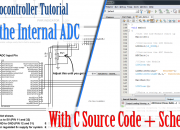
Using the ADC (Analog to Digital Converter) of PIC Microcontroller

Many electrical signals around us are Analog in nature. That means a quantity varies directly with some other quantity. The first quantity is mostly voltage while that second quantity can be anything like temperature, pressure, light, force or acceleration. For example in LM35 temperature sensor the output voltage varies according to the temperature, so if we could measure voltage, we can measure temperature. But most of our computer (or Microcontrollers) are digital in nature. They can only differentiate between HIGH or LOW level on input pins. For example if input is more than 2.5v it will be read as 1 and if it is below 2.5 then it will be read as 0 (in case of 5v systems). So we cannot measure voltage directly from MCUs. To solve this problem most modern MCUs have an ADC unit. ADC stands for analog to digital converter. It will convert a voltage to a number so that it can be processed by a digital systems like MCU. This enables us to easily interface all sort of analog devices with MCUs. Some really helpful example of analog devices are Light Sensors. Temperature Sensors. Accelerometers. Touch Screens. Microphone for Audio Recording. And possibly many more. In this tutorials we will learn to use the internal ADC of PIC18 devices (Example is for PIC18F4520 which is […]

Remote Controlled Fan Regulator using ATmega8

This device can be used to remotely control the speed of an AC fan and to switch it on or off. The remote control is a cheap NEC Format remote, usually supplied with small DVD players. Three buttons are used to command the circuit. The UP key increase the fan’s speed while the DOWN key decrease it. The ENTER key is used to switch on or off the fan. The unit provides 10 way speed control from 0 to 9. The current speed is displayed in a seven segment display. The yellow LED on the PCB indicates the power status of the load. If the load is switched off using the R/C then the LED will also be switched off. In the Video below you can check out the project in action. The main parts of the circuit is labeled below. The seven segment display used to show the current speed level. The TSOP1738 sensor is used to pick up commands from remote control. The Yellow LED indicates the power status of the load. OUT – Here the AC load is connected in series. Tested on 220v 50Hz AC line. IN – Power supply from a 12-0-12 transformer is applied here. MCU – ATmega8 AVR 8 bit Microcontroller. SWITCH – Manual Switch used to operate the unit without the remote […]